"Which Fuji should I buy?"
I get this question in my Instagram DMs almost every week. I make my living as a photographer, I shoot with a Fujifilm X-H2S and I create my own colour settings for Fuji cameras, so I get why people ask me. But at some point I noticed I was typing the same answers over and over again. So here they are, all in one place.
Two conversations finally pushed me to write this. The first came from a parent who had just got into photography. They wanted to shoot their kid, family portraits and birthday parties, mostly indoors, and maybe take on a few paid gigs later. Their budget was around $2,000 for camera and lens.
The second came from someone who had been looking for a camera for months before a safari. They had walked through shop after shop, even asked AI, and were still stuck between two models.
If you're in a hurry: get the X-S20 if it's going to be your only camera, get the X-M5 if you want something tiny, and spend whatever is left on a good lens. If you want to know why, keep reading.
All prices are list prices from November 2026, in euros with US dollars in brackets. In shops you'll often pay less.
A quick note on the photos: I only own the X-H2S, not every camera in this guide. The cover shows my own camera, the other camera photos come from photographers on Unsplash. You'll find their names under the photos and at the end of the post.
Links marked with * are Amazon affiliate links. If you buy something through them, I earn a small commission at no extra cost to you. As an Amazon Associate I earn from qualifying purchases.
You can't really go wrong
This took me a while to understand: on the inside, almost every Fuji you can buy today is very similar.
They all share the same "brain", the X-Processor 5. It creates Fuji's famous colours and runs the autofocus that finds and follows faces, eyes and animals. So a 900 € X-M5 and a 2,000 € X-T5 give you the same Fuji look, and colour settings like the ones I share work on both.
The real difference is the sensor, the part that actually captures your photo. Fuji uses two of them right now:
- X-Trans CMOS 4 with 26 megapixels, in the X-M5, X-T30 III and X-S20. That's plenty for Instagram, a photo book or a big print on your wall.
- X-Trans CMOS 5 HR with 40 megapixels, in the X-T50, X-E5, X-T5, X100VI and X-H2. You get more detail, so you can crop into a photo afterwards or print really big.
My own X-H2S is the odd one out. It has 26 megapixels too, but on the X-Trans CMOS 5 HS, a so-called stacked sensor that reads the image much faster. That's why it's so good for sport, wildlife and anything else that moves fast.
Honestly, for most people 26 megapixels is more than enough. Instagram shrinks every photo down to a tiny fraction of that anyway. The same goes for your phone, your laptop and a photo book, where 26 MP looks just as sharp as 40. Even a big A3 print on your wall comes out perfectly sharp. Only go for 40 if you love cropping into your photos afterwards or want to print really big, like a poster.
Beyond the sensor, what sets the cameras apart is everything around it: how big they are, whether you can look through a viewfinder, whether they keep your shots steady, and whether they survive a bit of rain. Here's how they compare:
- X-M5: 26 MP (X-Trans 4), tiny, no viewfinder, doesn't steady your shots, not sealed
- X-T30 III: 26 MP (X-Trans 4), small, viewfinder, doesn't steady your shots, not sealed
- X-S20: 26 MP (X-Trans 4), medium with a big grip, viewfinder, keeps your shots steady, not sealed
- X-T50: 40 MP (X-Trans 5 HR), small, viewfinder, keeps your shots steady, not sealed
- X-E5: 40 MP (X-Trans 5 HR), small and flat, viewfinder, keeps your shots steady, not sealed
- X100VI: 40 MP (X-Trans 5 HR), small with the lens built in, viewfinder, keeps your shots steady, sealed with an add-on filter
- X-T5: 40 MP (X-Trans 5 HR), medium, viewfinder, keeps your shots steady, sealed
- X-H2: 40 MP (X-Trans 5 HR), large, viewfinder, keeps your shots steady, sealed
- X-H2S: 26 MP (X-Trans 5 HS, stacked), large, viewfinder, keeps your shots steady, sealed
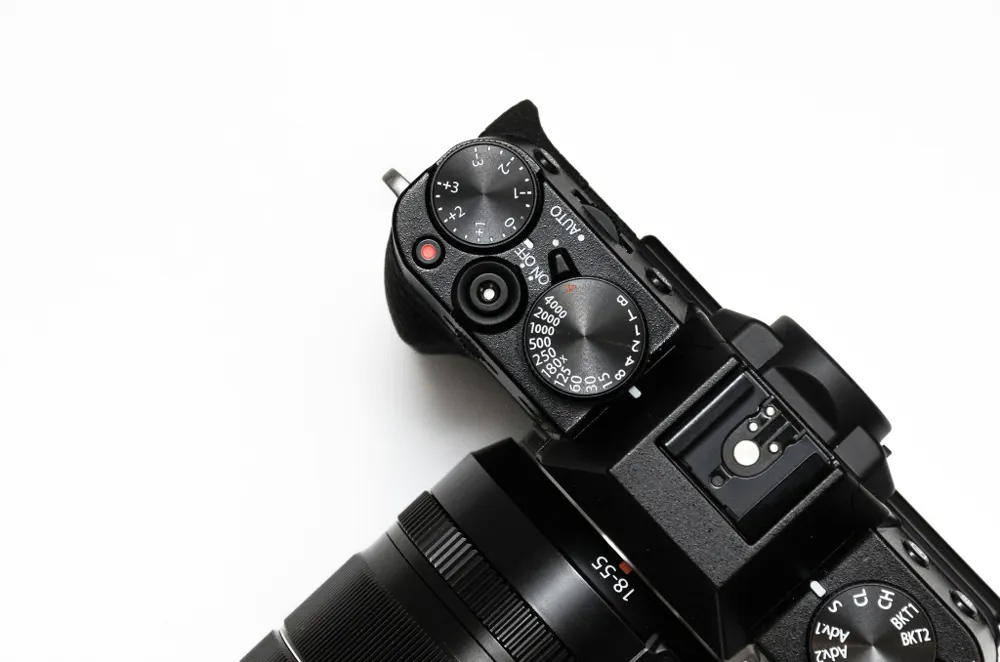
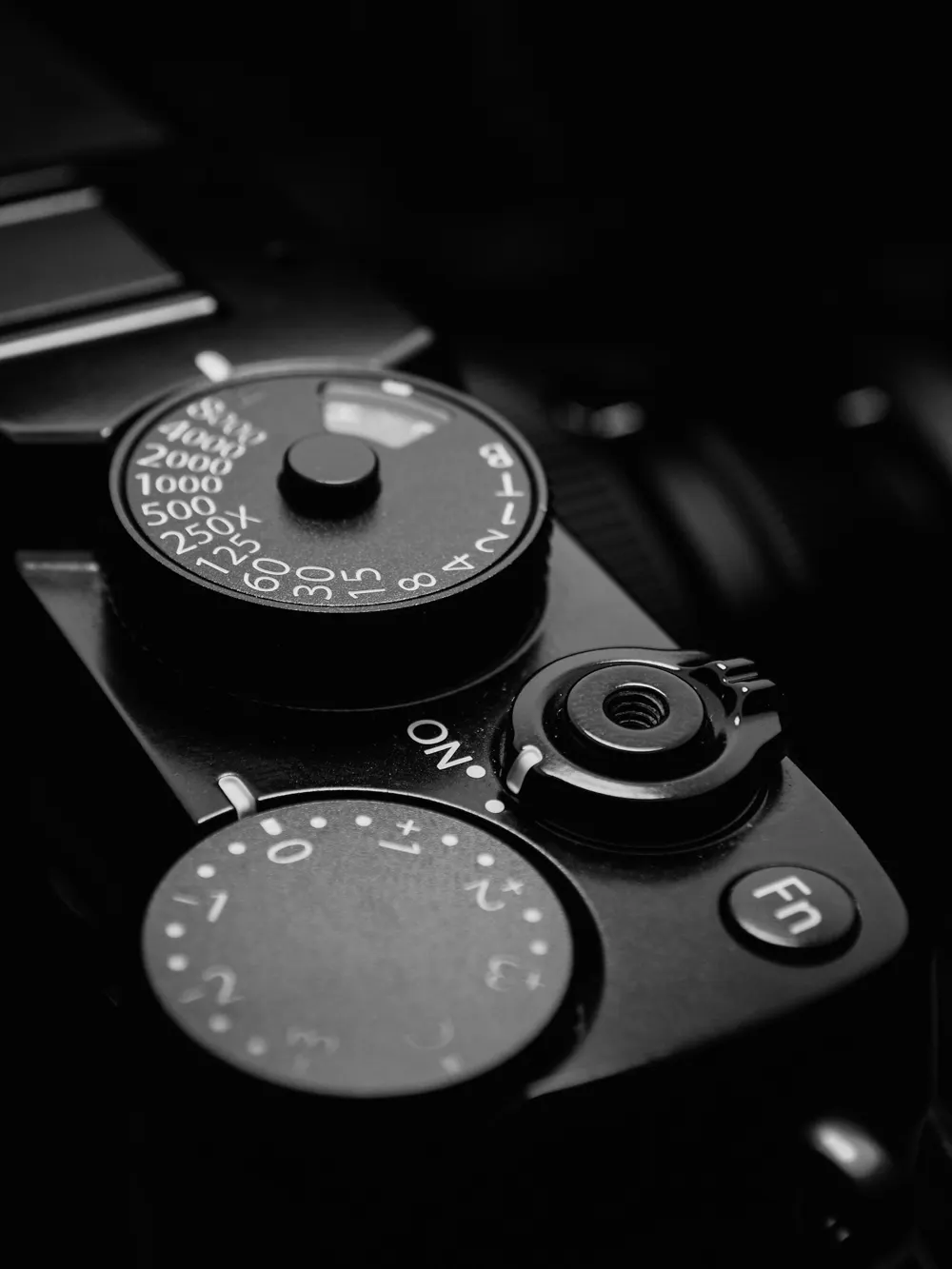
Some of them, like the X-T5 and the X100VI, have old-school dials on top, just like a film camera. That's a big part of the fun for me. If you're coming from Canon or Sony, the X-S20 and X-H2 will feel more familiar.
Three questions that decide it
Once you know that, choosing gets a lot easier. For most people it comes down to three questions.
1. How small does it have to be?
This was exactly the question in my second DM: X-M5 or X-S20?
The X-M5 is tiny, just 355 g. There's no viewfinder, so you frame your shot on the screen, like you would with your phone. It also doesn't steady your hands, so in dim light your photos can get a bit blurry if you're not careful. But it costs 899 € ($899), and you'll never leave it at home. I'm actually thinking about getting one myself, as the camera that's always in my bag.
The X-S20 has the same 26 MP sensor inside, so your photos will look the same. But it's the more complete camera. It has a proper grip, a viewfinder, and it keeps your shots steady even when your hands aren't. At 491 g it's still light. It costs 1,499 € ($1,499) and feels a lot nicer in your hand after a full day of shooting.
My answer back then was simple. If it's your only camera, take the X-S20. If you want a camera you'll carry everywhere, take the X-M5. Even better: go to a shop and hold both. You'll know within a minute.
2. Will it get wet?
If you shoot in rain, dust or sand, you want a camera that's sealed against the weather. If you don't, save your money.
Only the bigger cameras are sealed: the X-T5, X-H2 and X-H2S. The X100VI gets there with a small add-on filter from Fuji. The X-M5, X-T30 III, X-S20, X-T50 and X-E5 aren't sealed, so I wouldn't take them out in heavy rain or a sandstorm.
One thing people often miss: the lens needs to be sealed too. Fuji marks those lenses with "WR" in the name, short for weather resistant.
For birthday parties in the living room, you don't need any of this. For a safari, a hike or a day at the beach, it's worth every euro. I shoot most of my photos outdoors, ski touring, hiking and surfing, so my own camera is sealed.
3. Do you want to swap lenses?
"The X-M5 can't zoom, right?" That one came up in my DMs too. It can. Whether you can zoom depends on the lens you put on, not on the camera, and almost every Fuji lets you swap lenses.
The one camera where you can't is the X100VI. Its lens is built in and doesn't zoom. It's slightly wide, which is perfect for everyday life, streets and travel, and it makes you walk closer instead of zooming. In return you get the same 40 MP sensor as in the X-T5, in a camera that fits in a jacket pocket. It's just the wrong camera for a safari.
It's also hard to get. It costs 1,999 € ($1,799) and was sold out almost everywhere when I last checked. If you like the idea but want the option to change lenses later, look at the X-E5 with Fuji's small, flat 23 mm lens*. That set costs 1,899 € ($1,899).
Spend your money on the lens
If there's one thing I'd tell every beginner, it's this: don't put your whole budget into the camera. The lens decides how your photos look, especially when the light is low. And you keep it when you upgrade your camera later.
Kids indoors are the perfect example. Inside, the light is dim and kids never sit still. A camera that steadies your hands doesn't help much here, because it steadies you, not your kid. What helps is a "bright" lens, one that lets in lots of light. You can spot those by the number after the "f" in the name: the smaller the number, the brighter the lens. As a bonus, bright lenses give you that soft, blurry background.
So here's what I'd actually buy, depending on what you want to shoot.
You mainly want to photograph your kids
Get the X-M5* with the XF 33 mm f/1.4 lens, for about 1,748 € ($1,848). It's a very bright lens with a natural, classic look, and it's beautiful for portraits and indoor moments.
If you'd rather be able to zoom, take the X-S20* with the Sigma 18-50 mm f/2.8, for about 1,998 € ($2,048). It goes from wide group shots to close-up portraits and still stays small.
It's your first and only camera
Get the X-S20* with the XF 35 mm f/2, for about 1,948 € ($1,948). You get the good grip, the viewfinder and steady shots, plus a small, bright lens you'll leave on most of the time.
You're planning a safari or a big trip
For animals you need a lens that brings things close from far away. The XF 70-300 mm does exactly that, and it steadies the picture on its own. It costs about 750 € ($949).
On the X-S20 that's about 2,249 € ($2,448), and the big grip makes the long lens much easier to hold. The lens is sealed, the camera isn't, so pack a rain cover or a dust bag. If you want everything sealed, put it on the X-T5* instead, for about 2,749 € ($2,948).
You'd like to take paid gigs one day
Start with one of the setups above and get to know it really well. If the gigs come, move up to an X-E5* or X-T5*. Your lenses come with you.
You shoot fast action
Sport, wildlife, kids running around the garden: that's what my X-H2S is made for. Its stacked sensor keeps up with fast movement and can take up to 40 photos per second. At 2,749 € ($2,899) for the camera alone, though, it's more than most people need.
What everything costs
Here's every current Fuji, body only, from cheapest to most expensive:
- X half*: 799 € ($850)
- X-M5*: 899 € ($899), my pick if you want something small
- X-T30 III*: 949 € ($999)
- X-S20*: 1,499 € ($1,499), my pick if it's your only camera
- X-T50*: 1,599 € ($1,599)
- X-E5*: 1,649 € ($1,699)
- X-T5*: 1,999 € ($1,999)
- X100VI*: 1,999 € ($1,799)
- X-H2: 2,249 € ($2,299)
- X-H2S: 2,749 € ($2,899)
The euro prices are the German and Austrian list prices after Fujifilm raised them on 1 September 2026, the dollar prices are US list prices. In shops you'll usually find them cheaper. MediaMarkt Austria had the X-M5 at 789.99 €, for example.
Should you wait for the X-T6?
Only if you were going to buy an X-T5 anyway. For everyone else, it changes nothing.
The X-T6 has been rumoured for over a year. People expected it on 4 September, then on 19 November, and both dates passed without a launch. Now Fujifilm has announced an X Summit in Paris on 2 December, and its teaser ends on a red "6". Officially, though, nothing is confirmed. The rumours talk about a faster camera with better autofocus, for around 1,999 to 2,199 €.
My advice: if you need a camera now, buy one now. The photos you take this year are worth more than a spec sheet next year. And once the X-T6 is out, used X-T5s will get cheaper.
What about Canon or Sony?
The person from my second DM started out looking at Canon, then discovered Fuji, and then felt completely overwhelmed. That's normal. Every brand makes good cameras today.
With Canon or Sony, you first have to pick a sensor size: APS-C, the size Fuji uses too, or the bigger "full frame". Full frame cameras and their lenses are bigger, heavier and more expensive. Fuji keeps it simple. Apart from the little X half, every camera in Fuji's X series uses an APS-C sensor, which keeps everything small and light. I wrote more about that in my post on why I prefer APS-C over full frame.
For me, the real reason to pick Fuji is the look. You can set up your colours right in the camera, so your photos come out looking finished without any editing. I share my own colour settings, Fuji fans call them recipes, at danieljschwarz.com/recipes. And honestly, a Fuji just has more charm.
Don't overthink it
I know the feeling. When you're new to all this, the choice is overwhelming. But you really can't go far wrong with any of these cameras. Hold a few of them in a shop, pick the one you'll actually carry, put real money into a good lens, and then go out and shoot.
Still stuck between two models? Send me a DM on Instagram at @danieljschwarz. That's where this whole guide started, and I'm always happy to help.
Photos in this post: the cover shows my own X-H2S. The dials are by Maddy and the shutter speed dial is by Kenny, both on Unsplash. Thank you!